Maison Kanatha: A Japanese–French–Thai Omakase from the Kaneyoshi Group
FINE DININGFEATURED

Emerging from the Michelin-starred Kaneyoshi group, Maison Kanatha introduces a distinctly composed Japanese–French–Thai omakase in Los Angeles. This long-form feature moves beyond a conventional tasting narrative, tracing the menu course by course while grounding key dishes—such as ebi-shinjo, goma-dofu, unagi, and even reisei soup—within their historical foundations in Japanese culinary tradition. By establishing these lineages, the piece provides a more precise framework through which Maison Kanatha’s interpretations come into sharper focus. Through the collaboration of Chef Shingo Kato of Japan and Sous Chef Niki Nathathai of Thailand, each course is considered not only as an individual composition, but as a deliberate rearticulation of tradition. The contrast between canonical forms and Kanatha’s approach reveals a level of precision and creative intent that might otherwise remain understated—demonstrating how structure is preserved even as technique, seasoning, and cultural perspective are thoughtfully extended. In doing so, the piece invites a more informed reading of the menu, clarifying why this expression distinguishes itself within Los Angeles’s evolving fine-dining landscape.
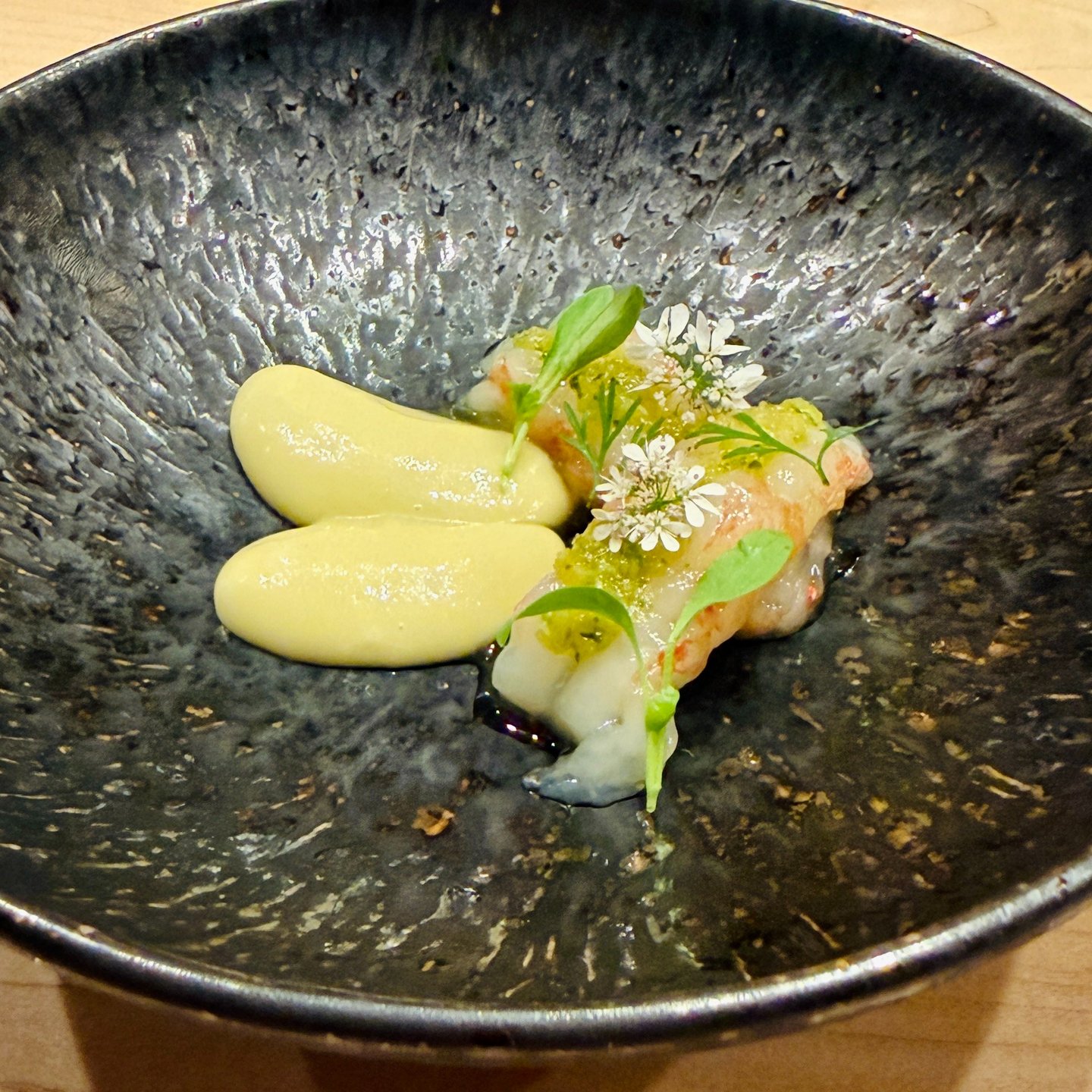
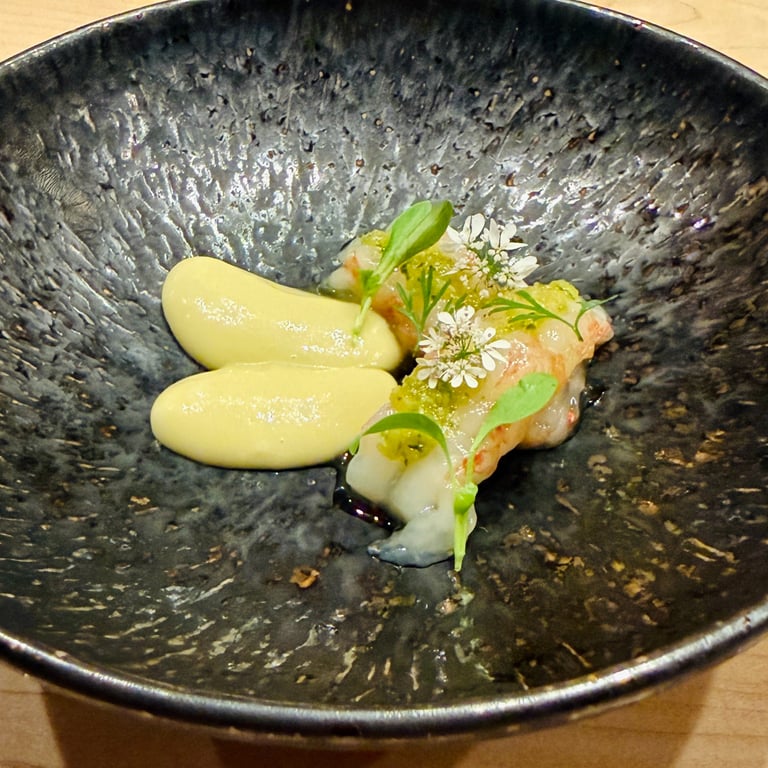
Maison Kanatha's Spot Shrimp Marinated in Fish Sauce (Photo by Junko Y.)
In October 2025, the Michelin-starred team behind Sushi Kaneyoshi unveiled a quietly ambitious undertaking: Maison Kanatha, a Japanese–French–Thai tasting concept that signals a deliberate evolution beyond Edomae orthodoxy. Since introducing dine-in service at Sushi Kaneyoshi in April 2021, Chef Yoshiyuki Inoue has not only secured a Michelin star but also broadened the group’s portfolio with Bar Sawa and Restaurant Ki—a trajectory achieved in less than five years that affirms his stature not merely as a disciplined sushi master, but as a strategic restaurateur shaping a broader culinary vision.
Served within Sushi Kaneyoshi’s intimate dining room from Friday through Monday, Maison Kanatha’s tasting menu is the collaborative expression of Chef Shingo Kato of Japan and Sous Chef Niki Nathathai of Thailand. With only nine to ten seats each evening, the counter experience remains intimate—yet the restaurant has been filling steadily despite being only five months old.
Chef Kato, classically trained for over a decade at the Imperial Hotel in Japan, held distinguished international appointments—including Official Residence Chef at the Permanent Mission of Japan to the United Nations in New York and Official Chef at the Embassy of Japan in Latvia—roles entrusted to chefs capable of articulating Japanese culinary tradition and technique on a global stage. He later contributed to the openings of Michelin-starred establishments such as Uka and Restaurant Ki. With more than fourteen years of experience, he now channels internationally honed Japanese finesse into a distinctly personal voice, in dialogue with Chef Niki’s Thai sensibility.
The restaurant’s name encapsulates both partnership and aspiration. “Kanatha” fuses Kato and Nathathai, while echoing the Japanese word kanata—“beyond” or “far away.” “This is not fusion but harmony,” the chefs note. It is an apt metaphor for two culinary minds from divergent cultural lineages seeking to move guests past the expected coordinates of fusion, toward a tasting experience that does not merely hybridize traditions, but transcends the ordinary.
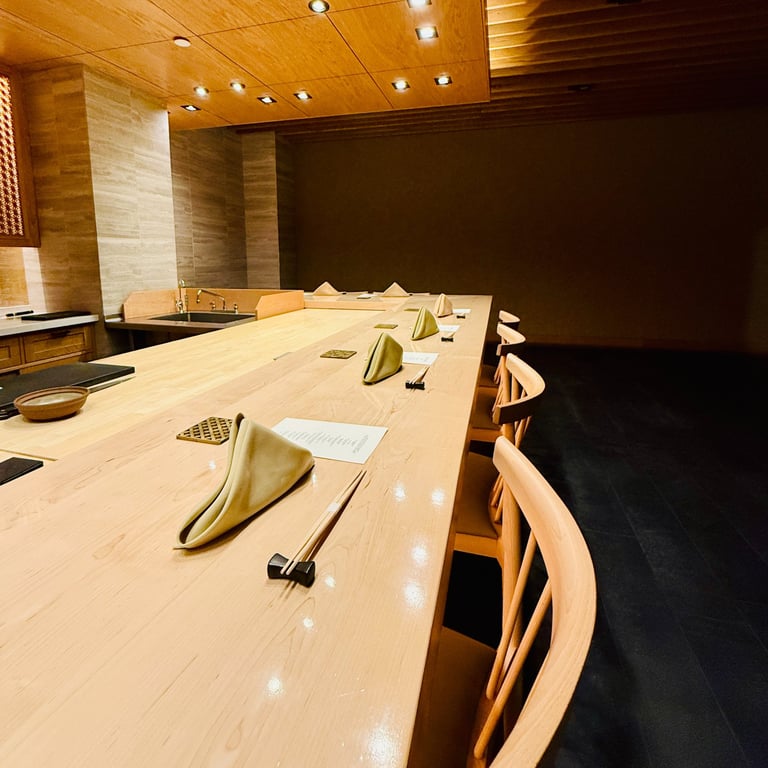
Kanatha's Counter (Photo by Junko Y.)
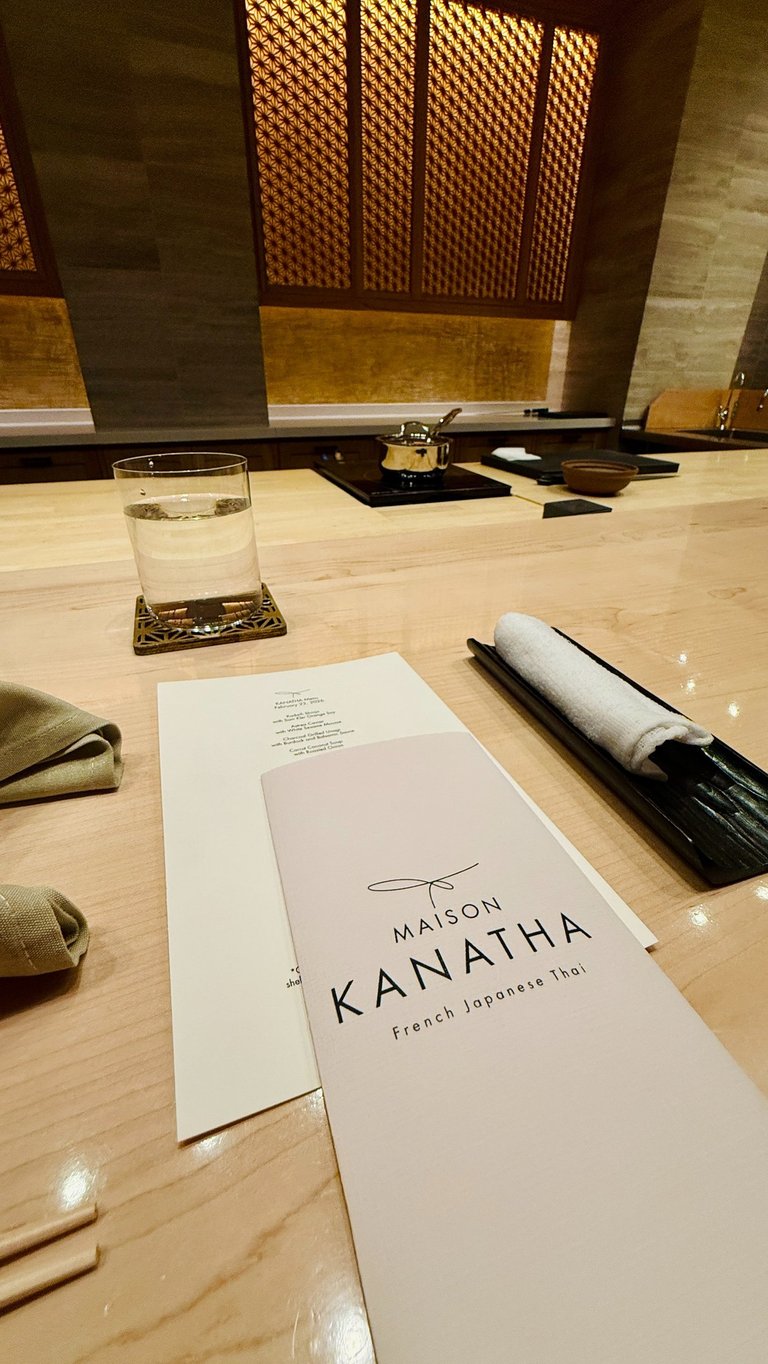
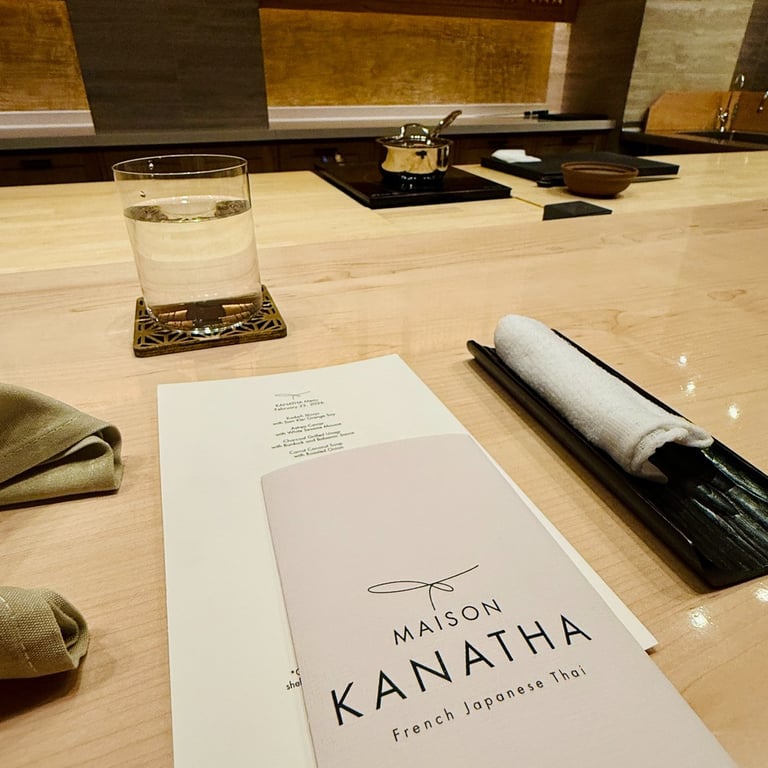
The Main Savory Sequence
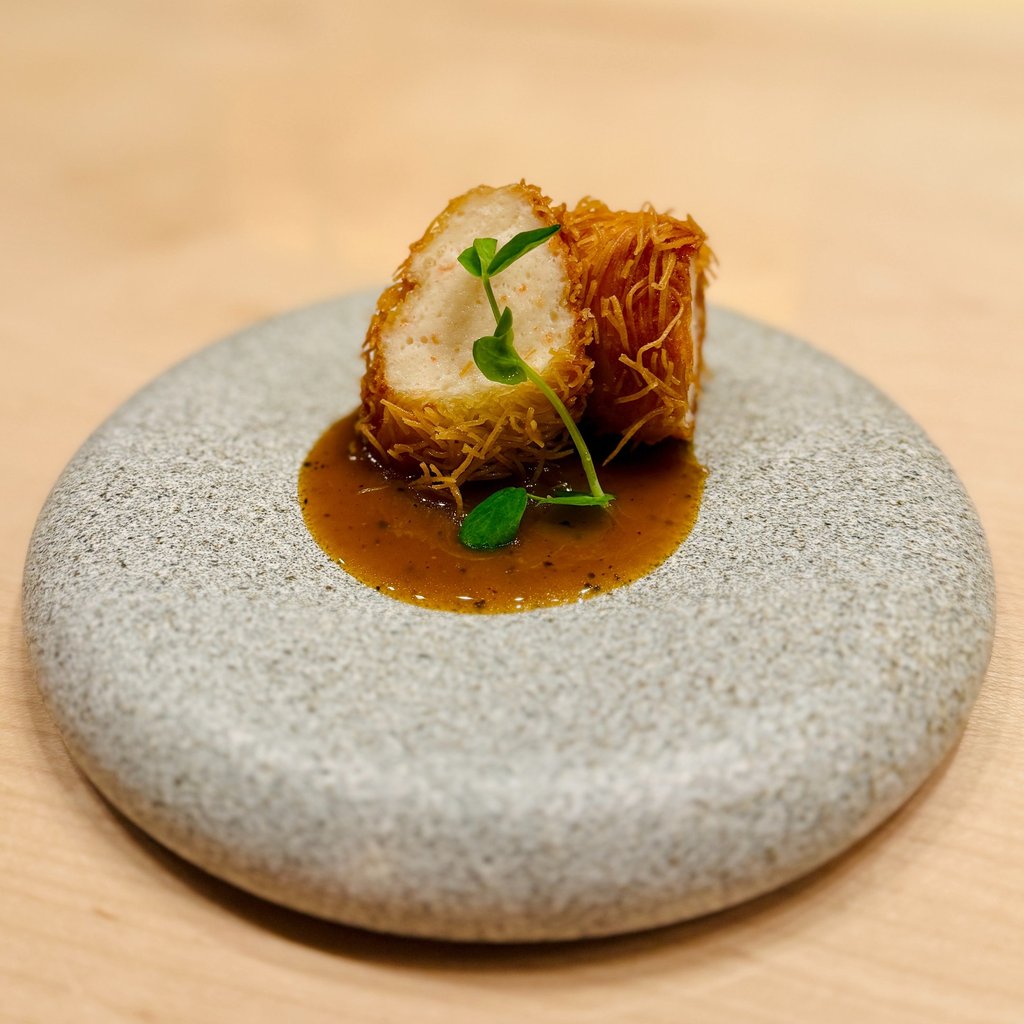
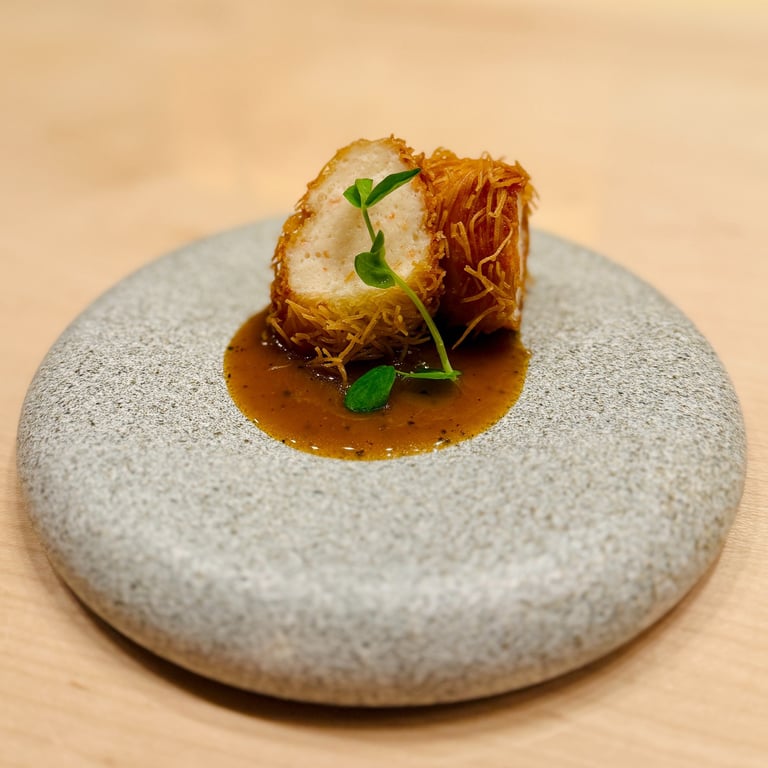
Kadaifi Shinjo (Photo by Junko Y.)
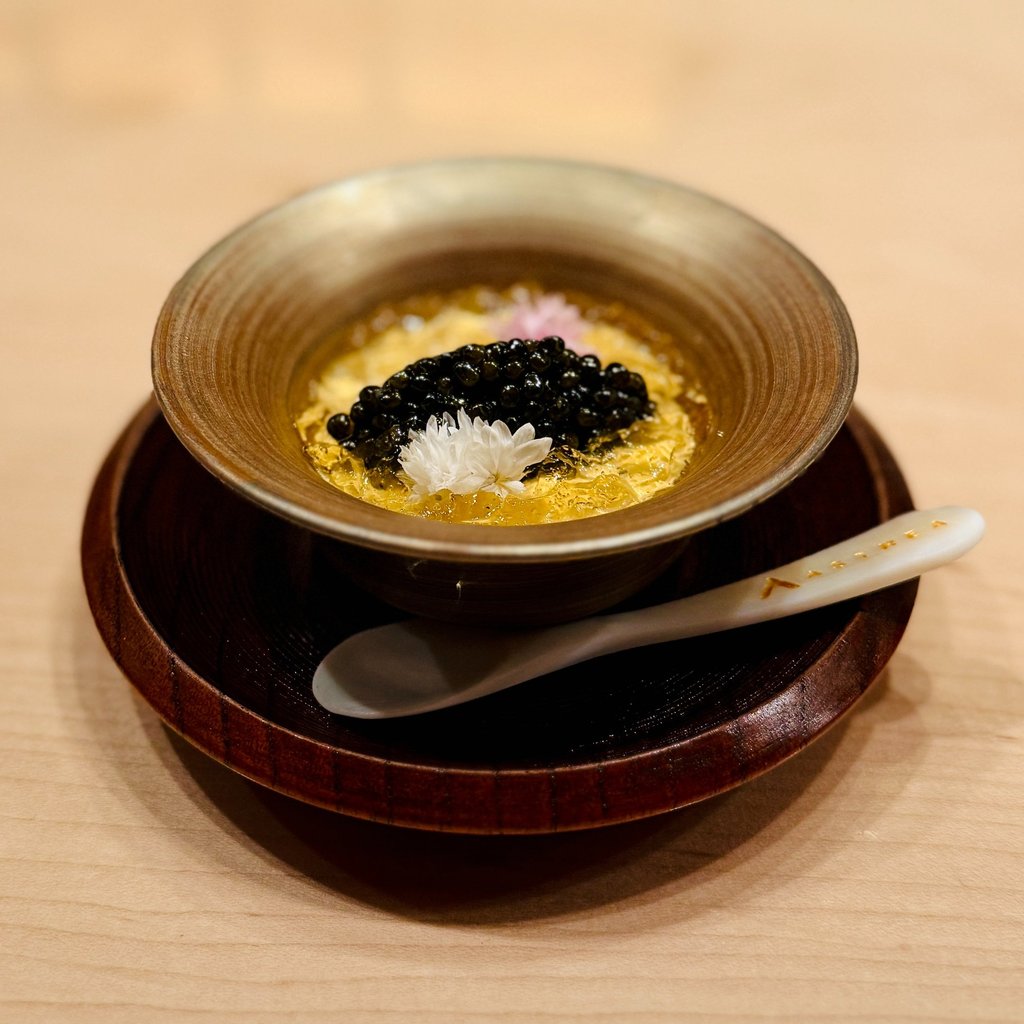
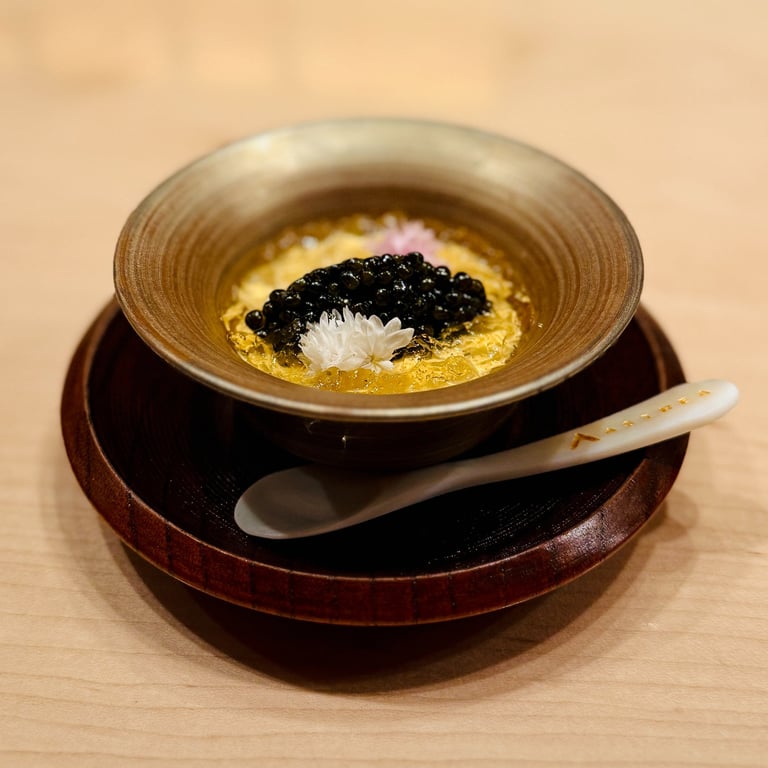
Astrea Caviar (Photo by Junko Y.)
The tasting opened with ebi-shinjo—a shrimp cake wrapped in crisp kadaifi and deep-fried—accompanied by a sam kler orange soy sauce layered with Thai paste and the aromatic lift of cilantro root. In classical kaiseki, ebi-shinjo occupies a venerable place: ebi denotes shrimp; shin points to the essence of the shrimp or fish paste; jo refers to grated mountain yam, the traditional binder that lends buoyancy and suppleness. With a lineage spanning more than two centuries, it is often presented in broth or delicately fried. At Kanatha, the structure remains intact, yet its contours are gently reframed—fried to a delicate golden crisp, then brightened by Thai spice and herbal nuance.
As an opening gesture, the dish quietly recalibrated expectation. Introduced simply as “shrimp cake,” and arriving golden from the fryer, it visually suggested a direct, shrimp-forward declaration—the kind of emphatic crustacean intensity familiar in California fine dining. Instead, the emphasis turned inward. The interior revealed a refined, elastic cohesion; the kadaifi fractured into fine, filament-like shards. Rather than amplifying salinity or richness, the composition highlighted texture and the restrained, lingering sweetness inherent in the shrimp itself. The sauce, sweet-and-sour with a measured warmth, served as counterpoint rather than crescendo, sharpening perception and drawing the shrimp’s subtle amami into clear focus. As an opening statement, the dish set the tone with clarity and composure.
The subsequent caviar composition continued that dialogue. A white sesame mousse formed the base, within which small dice of monkfish liver, ankimo, were embedded. A translucent gelée of dashi and soy sauce lightly cloaked the surface, crowned with Astrea caviar. “Goma-dofu reimagined in a Western style,” Chef Kato noted—a remark that heightened anticipation.
Goma-dofu predates ebi-shinjo by centuries, its origins in shojin cuisine, where it nourished monks in ascetic practice. Despite its name—goma (sesame) and dofu (tofu)—it contains no soy, but sesame paste generally set with kuzu starch, yielding its characteristic suppleness. One bite—and the chilled temperature awakened the palate. The shiro goma base was silken and elegantly sweet, its composure tightened by the restrained savory flavor of the gelée. The caviar added a further refined layer of brine, each component resonating in poised equilibrium. Only then did the ankimo unfold, its depth and humble, velvety richness brought into focus by the surrounding structure.
Across these opening courses, a distinct philosophy revealed itself. The principal ingredients—shrimp and monkfish liver—were not magnified through intensity; they were instead elevated through orchestration. Surrounding elements were calibrated with precision, allowing harmony, rather than volume, to define the experience.
The next course featured charcoal-grilled unagi, accompanied by burdock in two expressions: a silken purée and fine shards fried to a brittle crisp. A trace of cilantro powder, paired with balsamic vinegar, lent a subtle fragrant lift.
Japan has one of the longest culinary relationships with unagi (eel), with a history that spans centuries. Over time, an exacting craft took shape around its preparation—particularly in the crafting of tare, the sauce that defines the dish. The soy sauce–based unagi’s tare recognizable today took shape in the late Edo period, during what is often described as a “seasoning revolution.” In long-established eel houses, the practice of tsugi-tashi—continually replenishing the sauce—remains central: small amounts of new tare are added to the old, allowing rendered eel fat and accumulated umami to deepen the sauce’s complexity over years, sometimes decades. Within those pots resides not only flavor, but a continuity devotedly passed down through generations.
In this context, Kanatha’s tare was sensibly restrained. It did not rely on sugar or viscosity; the texture remained light, allowing the smokiness of the charcoal to come through clearly. The overall impression was balanced and fire-led rather than dominated by sauce.
The unagi itself was carefully cooked—gently crisp at the surface, with flesh that remained tender and airy within. The burdock, presented as both purée and crisp, introduced contrast in texture and a subtle earthy bitterness that framed the eel’s intrinsic taste without overwhelming it. As in the earlier courses, the focus remained on clarity of the main ingredient, supported rather than exaggerated, in harmony.
What followed was a lighter, pleasantly unexpected turn: carrot coconut soup with roasted onion. A chilled carrot base was enriched with coconut cream, while roasted pearl onions rested on the surface. A delicate tuile spanned the bowl, designed to be broken at the table, collapsing into the soup in fine shards.
Within a traditional French progression, warm soups often anchor the early savory courses. In Japanese interpretations of French fine dining, however, reisei (chilled) soups frequently appear—particularly in warmer months—serving as a measured bridge or refreshment between opening bites and subsequent warm dishes. This format has become profoundly familiar in Japanese-French tasting menus, where the cold soup itself becomes part of the narrative structure.
Here, the choice felt both clever and thoughtful. Chef Kato’s classical Japanese-French foundation met Chef Niki’s light Thai touch in a way that felt natural rather than declarative. The coconut was handled with notable sensitivity—present, yet controlled—leaving a gentle, creamy aftertaste that lingered softly after each spoonful. Positioned after the unagi course, the chilled soup served as a deliberate transition—cooling and refreshing the palate. The roasted onion brought a koubashii, charcoal-forward aroma, while the crisp tuile added textural contrast and a subtle element of play. Together, the elements articulated French, Japanese, and Thai harmony in a manner that was both composed and quietly expressive.
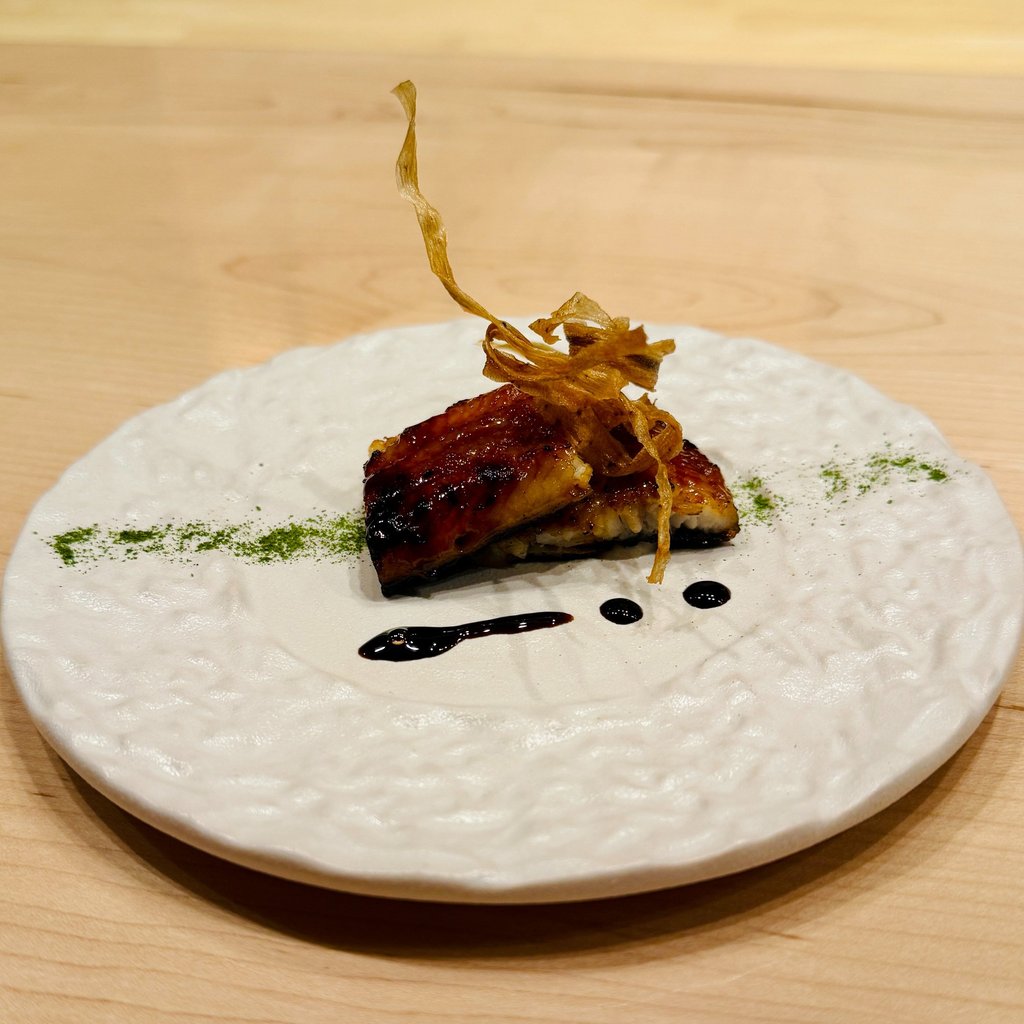
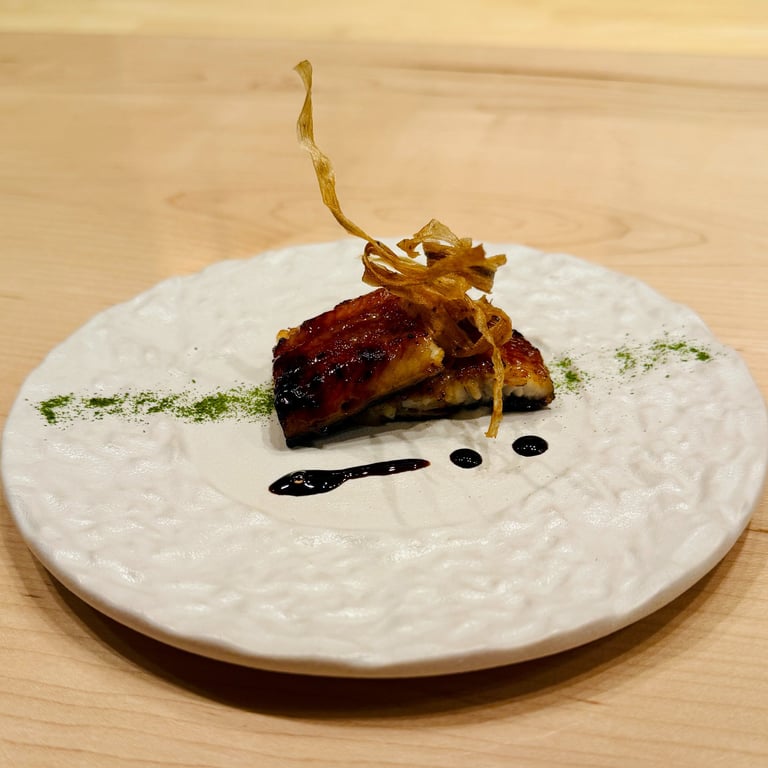
Charcoal Grilled Unagi (Photo by Junko Y.)
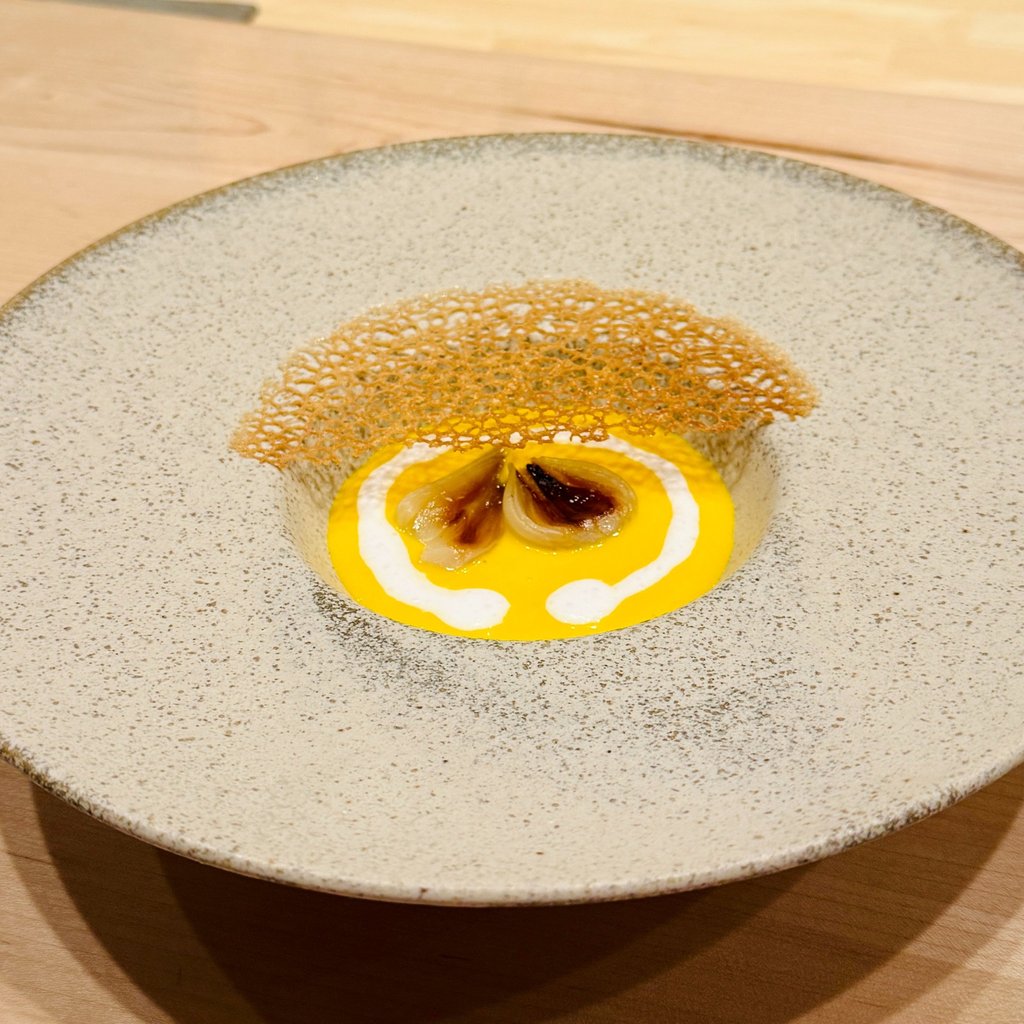
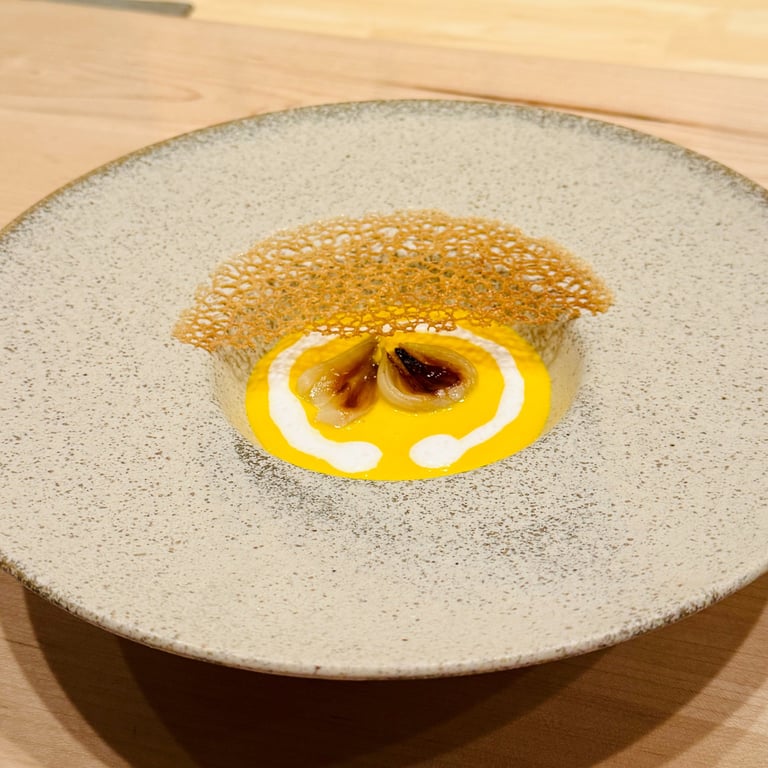
Carrot Coconut Soup (Photo by Junko Y.)
From this point, two courses deliberately positioned to assume the role of muko-zuke within the progression. In traditional kaiseki, muko-zuke—typically served after the soup—signals the beginning of the main portion of the meal and often takes the form of sashimi. Its purpose is straightforward yet important: to allow guests to appreciate the quality of an ingredient at its seasonal peak, demonstrating both the restaurant’s sourcing and the chef’s handling of pristine seafood.
At Kanatha, two courses arrived before the warm main dishes in a manner that echoed this role. The first was a crispy tart with squid and turnip, seasoned with black olive and a light touch of lemon. The construction was carefully balanced so that the clean, distinct flavor of the squid remained at the center, with the citrus offering a gentle brightness.
The second featured botan-ebi (spot shrimp), accompanied by bitter melon purée and Thai seafood sauce. The shrimp sashimi, lightly marinated in fish sauce, was topped with Thai seafood sauce made with cilantro root, garlic, and mint, with bitter melon purée placed alongside. In classical muko-zuke, sauces are typically minimal—often no more than soy sauce or salt—so that the pure taste of the seafood can be appreciated. Introducing Thai aromatics with garlic and cilantro could slightly risk overpowering the delicacy of the shrimp.
Here, however, the intensity was deliberately moderated. The Thai seafood sauce appeared only as a faint echo—honnori, a gentle presence that lingered softly in the aftertaste without obscuring the botan-ebi’s pristine flavor. It is an example of the chefs extending the framework of tradition while still respecting its core principle. In the classical kaiseki sense, this stage of the meal is where a restaurant demonstrates the quality of its ingredients and the skill with which they are handled. At Kanatha, that idea remained intact—even as Thai accents were introduced—ultimately reinforcing the Japanese culinary ideal of drawing out the inherent excellence of the ingredient itself.
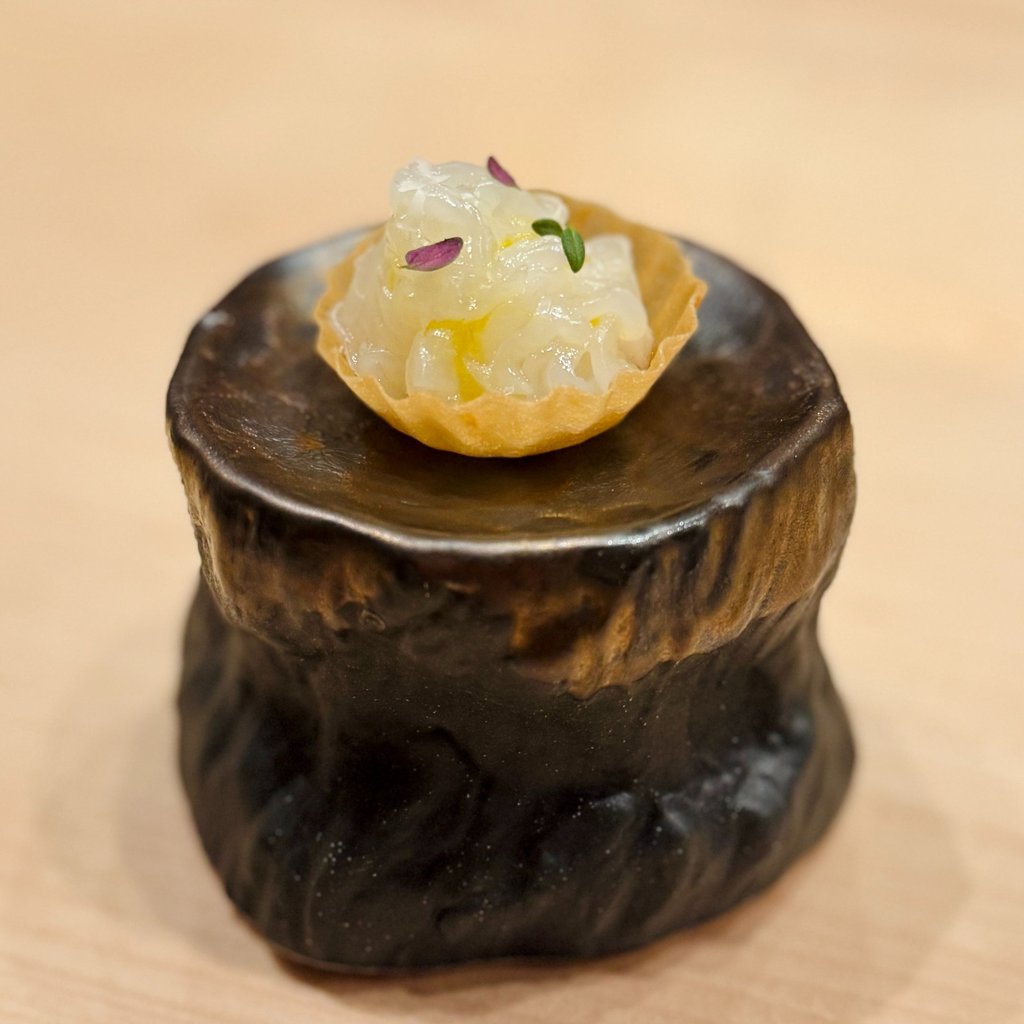
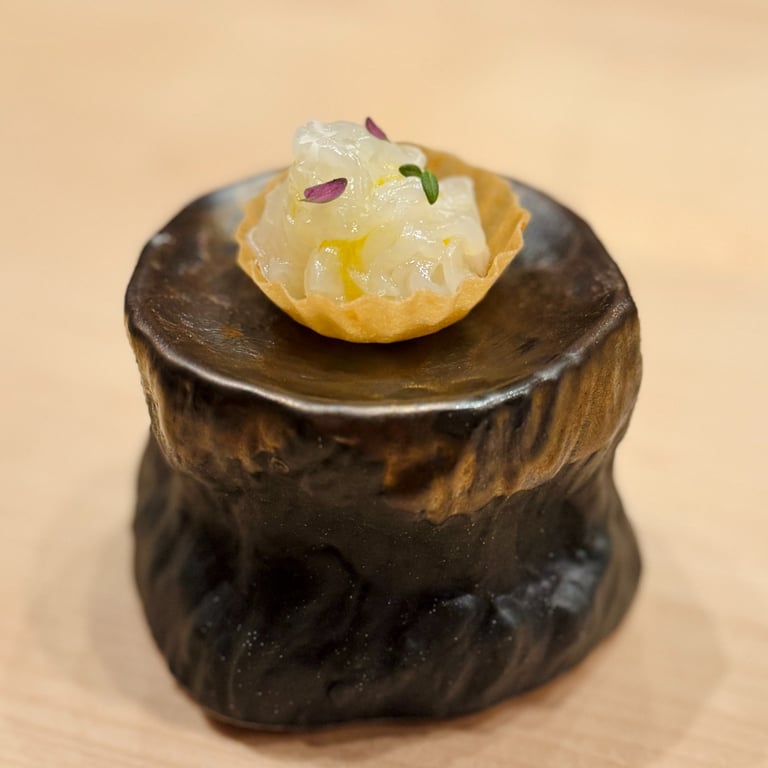
Crispy Tart (Photo by Junko Y.)
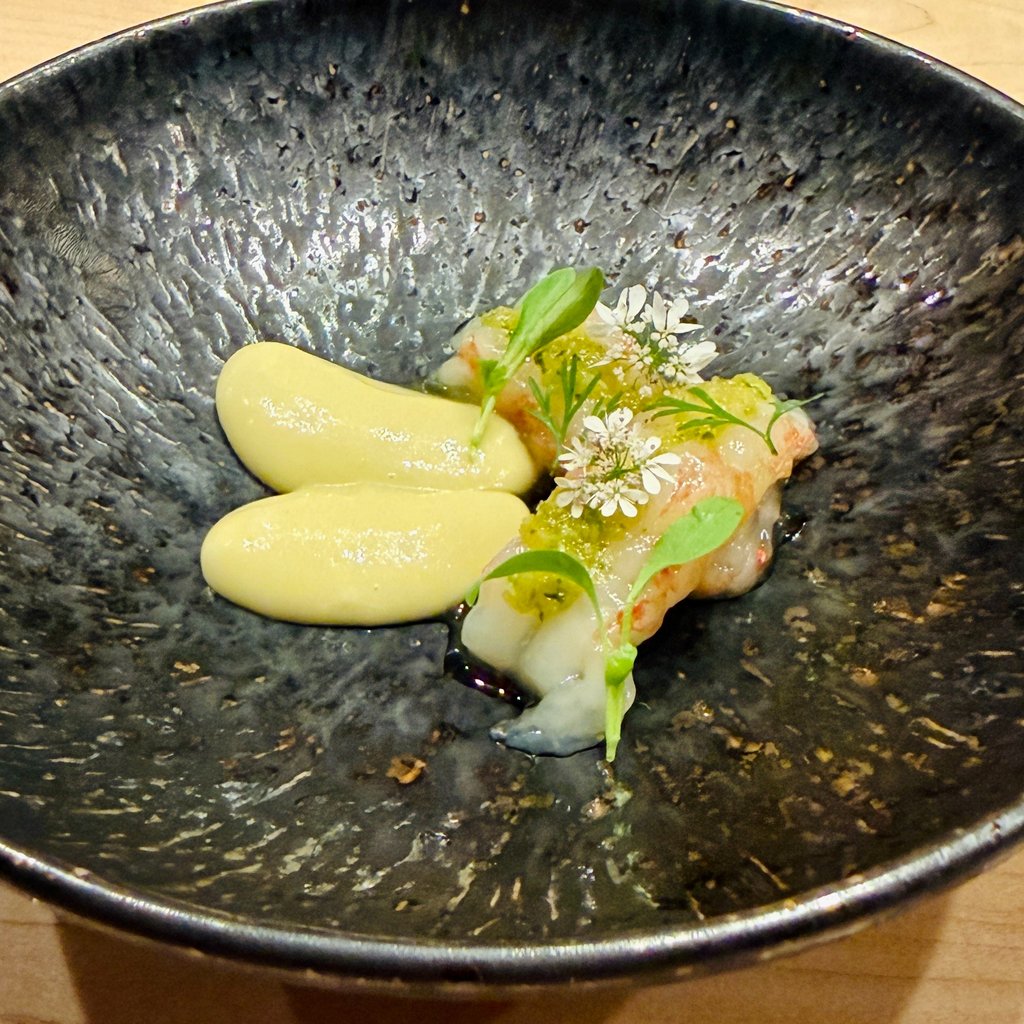
Spot Shrimp Marinated in Fish Sauce (Photo by Junko Y.)
Following the courses that echoed the role of muko-zuke, the progression moved into the main dishes. One of them arrived in a playful form: a mini burger. The sandwich was built with house-made milk bread, layered with cream cheese, shiso, and pickled apple, and finished with charcoal-seared bluefin tuna. Just before the dish was served, Chef Niki stepped forward at the counter and briefly seared each slice of tuna over charcoal. The rising smoke carried a distinct, appetizing scent, preparing the guests even before the first bite.
Despite its appearance—and the expectations that the word “burger” might suggest—the dish felt pleasantly light. Rather than heaviness, the impression was uplifting and deeply satisfying, encouraging another bite almost immediately. The balance was thoughtfully considered: the smokiness of the tuna was countered by the gentle tartness of the pickled apple and the herbal lift of shiso, while the milk bread contributed a soft sweetness that brought the elements together.
Chef Kato noted that the dish has remained on the menu since the opening, and several returning guests at the counter mentioned that it is one of their favorite courses at Kanatha. After tasting it, the reason became clear. The flavors align so naturally that the composition becomes instinctively compelling—an example of how a seemingly playful idea can resolve into something memorably well-balanced.
Next came green curry in pani puri with snow crab. Together with the preceding mini burger, this course stood out as one of the dishes that left a particularly lasting impression—and one that easily makes a guest want to return to Kanatha.
The dish arrived as a single composed bite. Chilled green curry filled a crisp pani puri shell with rice cookie and dashi soup. On top sat a generous amount of snow crab mixed with crab miso. The first taste leaned toward the familiar aromatic profile of Thai green curry, but gradually the amami of the crab emerged, rounding the flavor with a distinct oceanic depth. The thin pani puri shell shattered lightly, adding a crisp, engaging texture.
What stood out again was how controlled the Thai element was. Green curry can easily dominate a delicate ingredient like snow crab, yet here it acted as a precisely measured accent. Rather than overpowering the crab, it seemed to draw out its natural character. The other components—the pani puri and the gentle layer of the dashi—also worked discreetly in the background to support the main ingredient.
It was a memorable bite: lively, rich, and finely balanced.
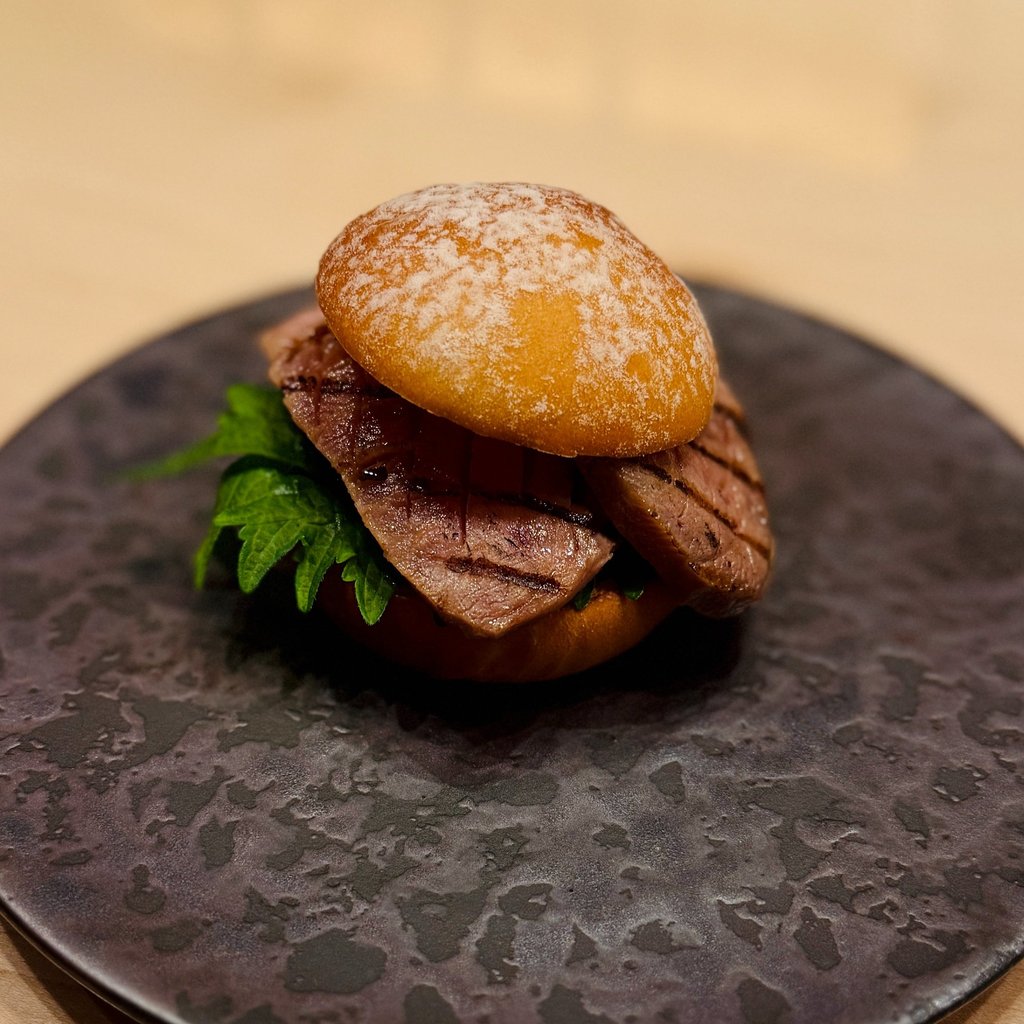
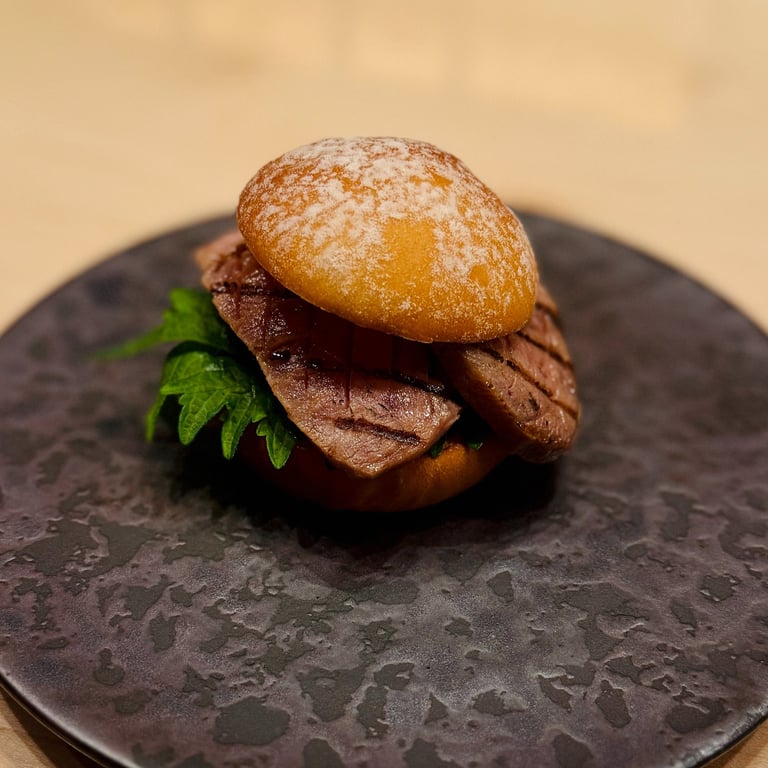
Mini Burger (Photo by Junko Y.)
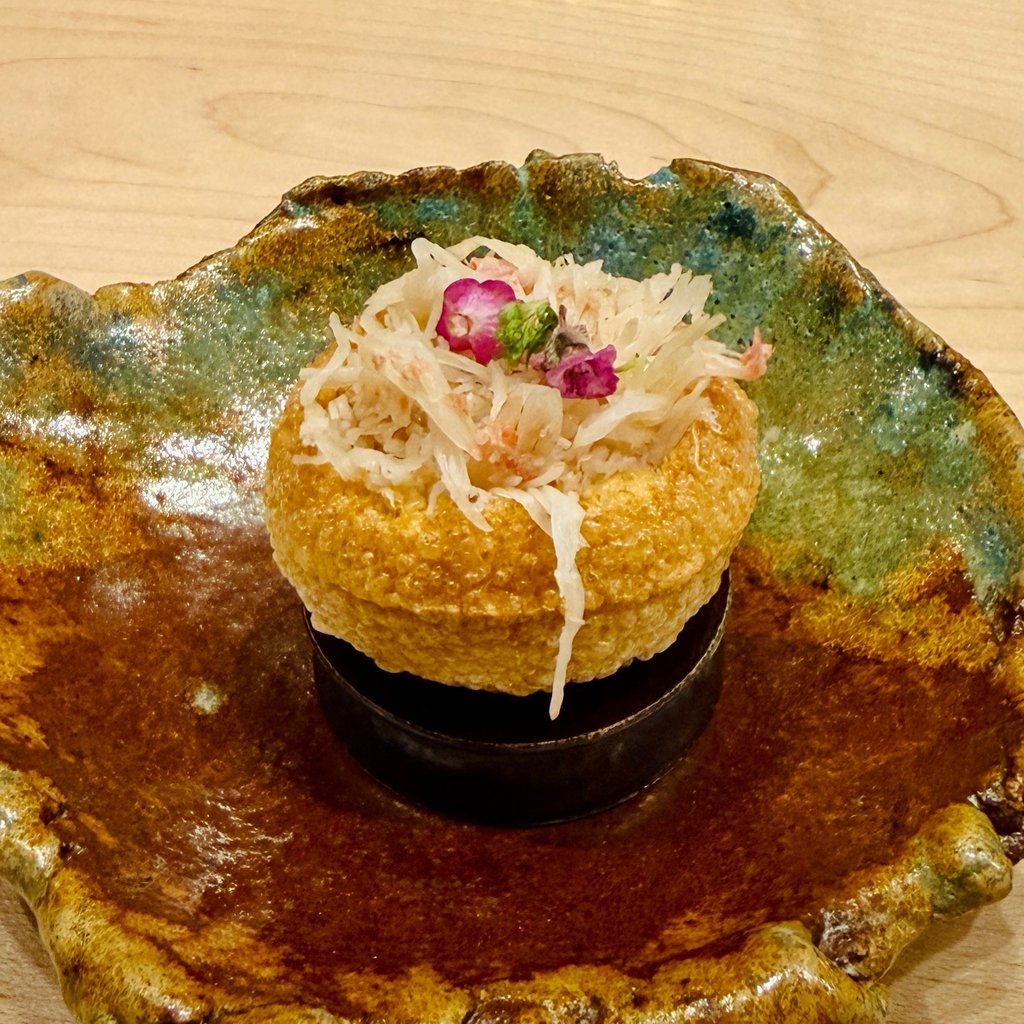
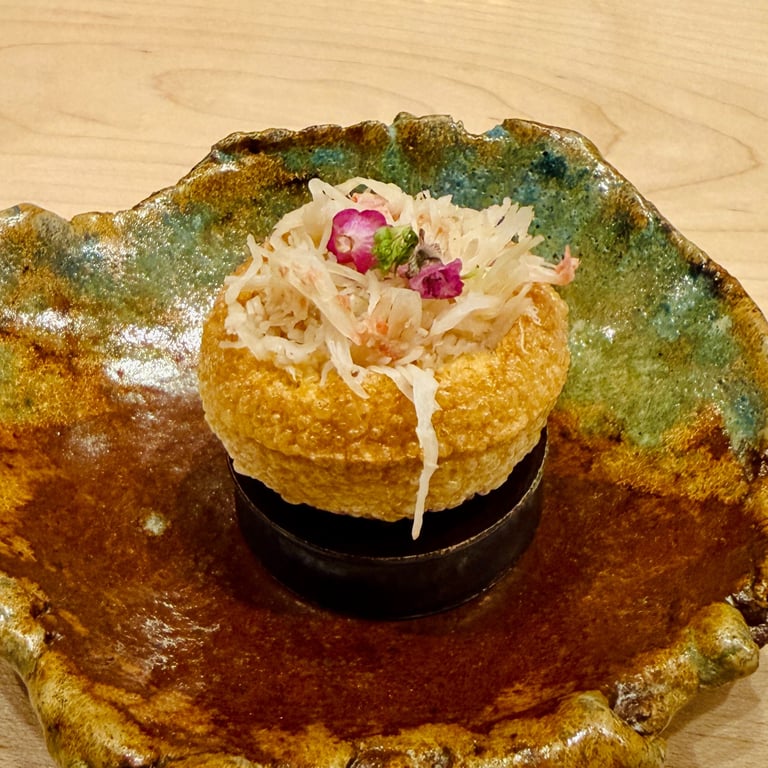
Green Curry (Photo by Junko Y.)
Chawanmushi—the delicate Japanese savory egg custard—arrived next, prepared with chicken, spinach, and shiitake mushroom. Crowned above the custard was a layer reminiscent of French onion soup, though here the broth drew its depth from fish stock rather than beef. Chawanmushi has long been a familiar fixture of kaiseki menus in Japan, yet in California’s fine-dining landscape it has recently become common to encounter elaborate interpretations adorned with luxury ingredients.
Against that backdrop, Kanatha’s version stood out as modestly distinctive. The filling remained deliberately classic—chicken, spinach, shiitake, and a refined dashi—allowing the custard’s understated character to lead. Pairing it with an equally familiar reference to French onion soup might appear unexpected, yet the two elements met with surprising harmony. The flavors were balanced and composed, with a gentle citrus brightness threading through the broth. The chicken was tender, the custard smooth and poised.
In that sense, the dish a measured convergence of wafū (Japanese style) and yōfū (Western style). It also worked effectively as a transition to the courses that followed, grounded in a dashi-forward sensibility while quietly acknowledging Western influence.
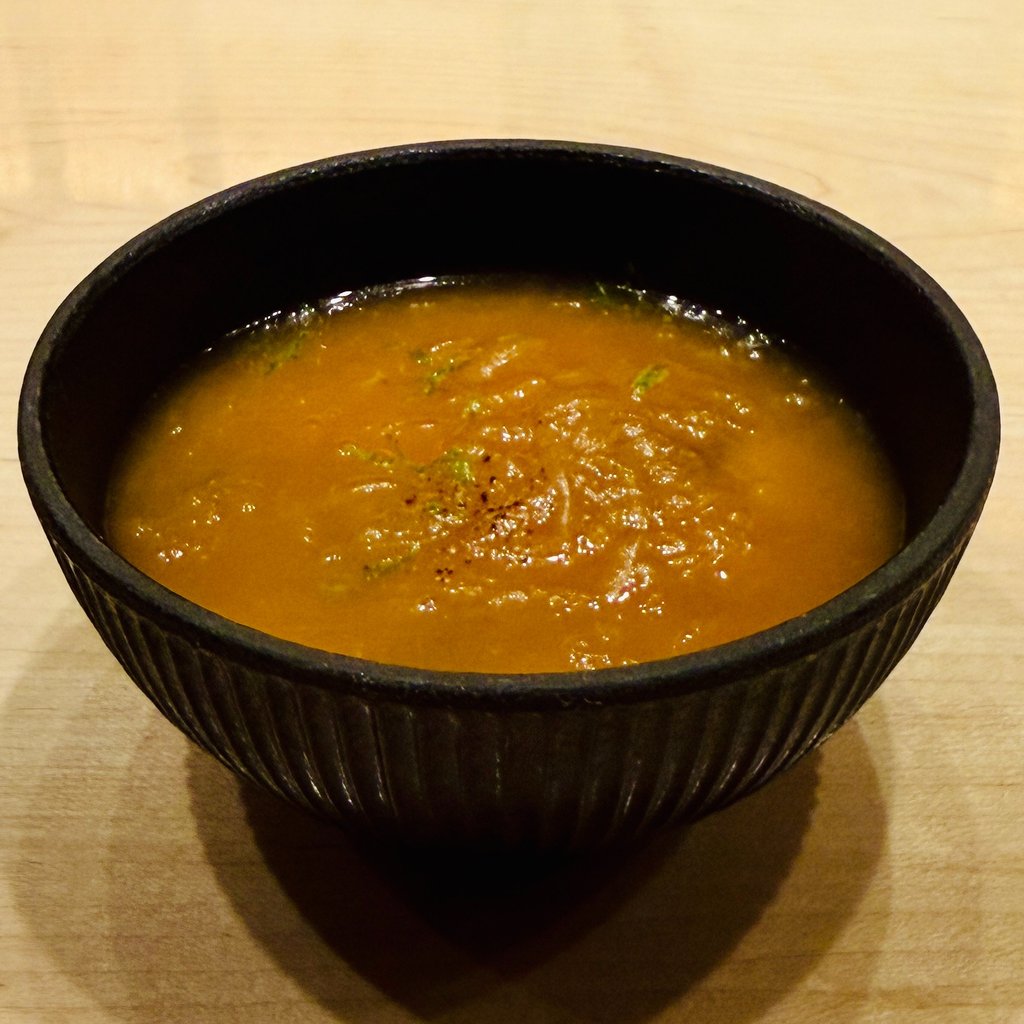
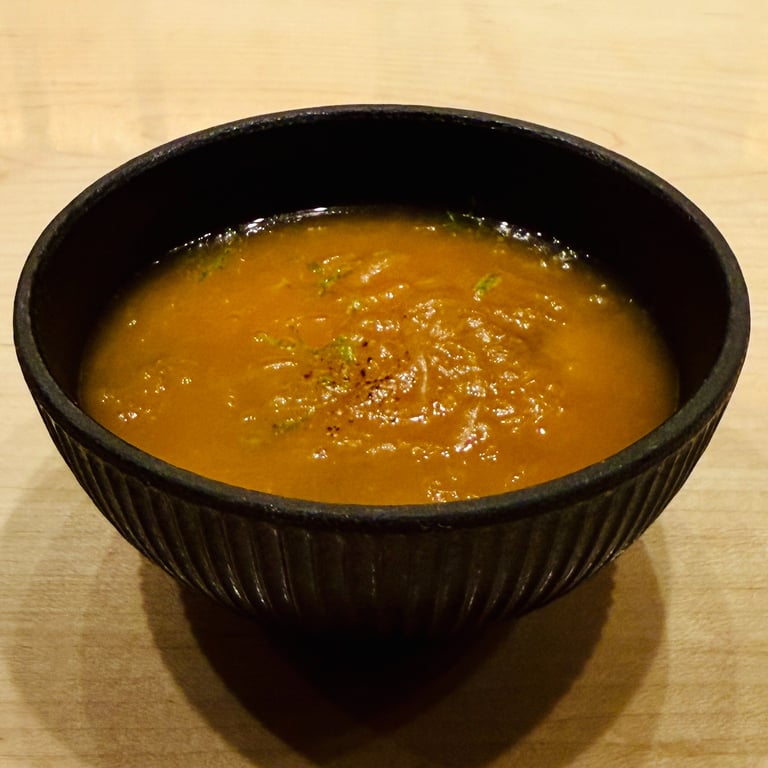
Chawanmushi (Photo by Junko Y.)
After this warm interlude came sawara—king mackerel—presented as a French-style beignet with fennel purée and soy sauce brown butter. The batter incorporated dried seaweed, recalling the kaiseki preparation known as isobe-age, a refined fried dish that highlights the fragrance of nori. Kanatha’s interpretation arrived immediately after frying, the exterior offering a light, airy crispness while the fish inside remained tender. The oceanic flavor of the sawara was lifted by the aroma of the seaweed and a gentle toasted note. Beneath it, the fennel purée brought a soft, buttery richness, while the soy sauce brown butter added a supportive depth that complemented the fish without overwhelming it.
The following course introduced American Wagyu from Snake River Farms in Idaho, served with tamarind sauce and accompanied by grilled tomato and broccolini. This was the one dish that I personally found a bit more challenging to fully appreciate. The sauce carried a pronounced tang and an aromatic sharpness that felt unfamiliar to my Japanese sensibility, at times drawing attention away from the beef itself. The wagyu was properly cooked, though the texture was slightly firmer than anticipated. This reaction likely reflects my own cultural perspective rather than any shortcoming in the kitchen; Thai flavors and spices are simply less familiar to my personal frame of reference.
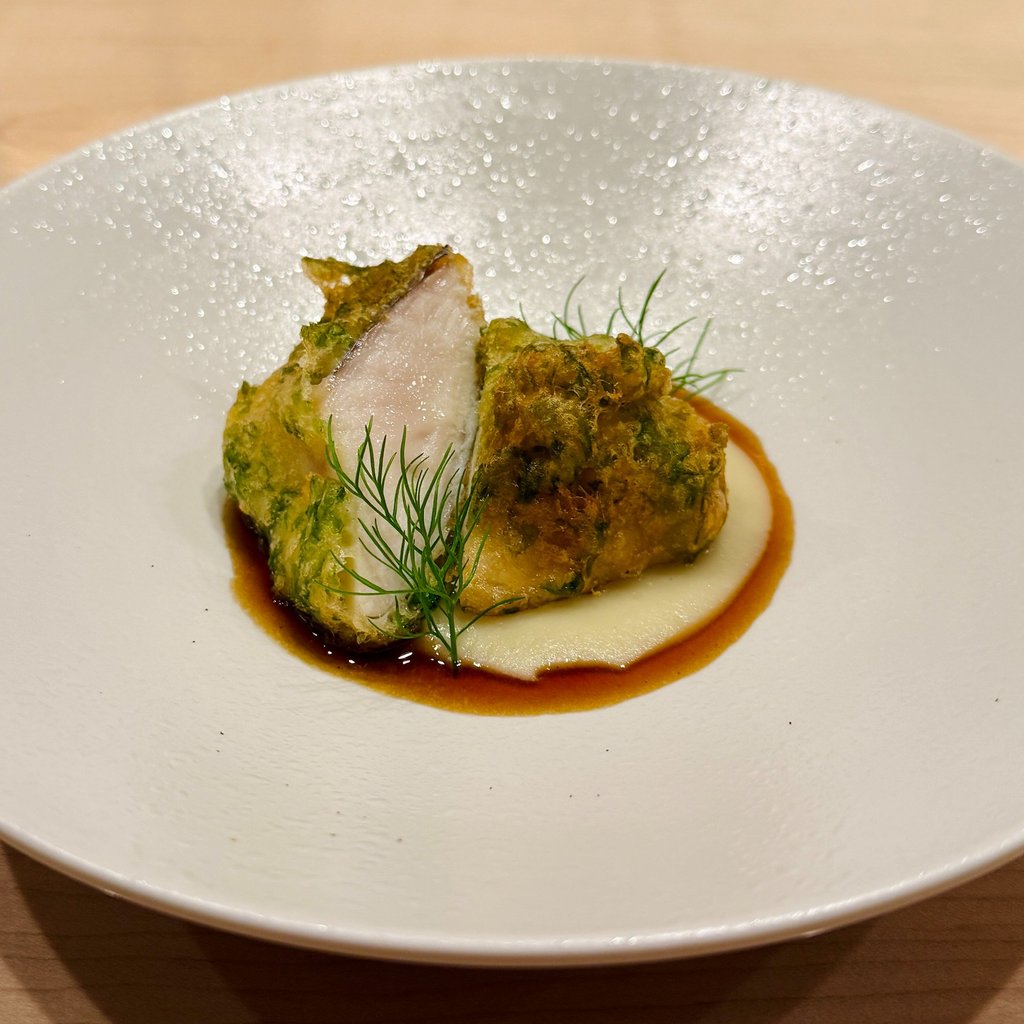
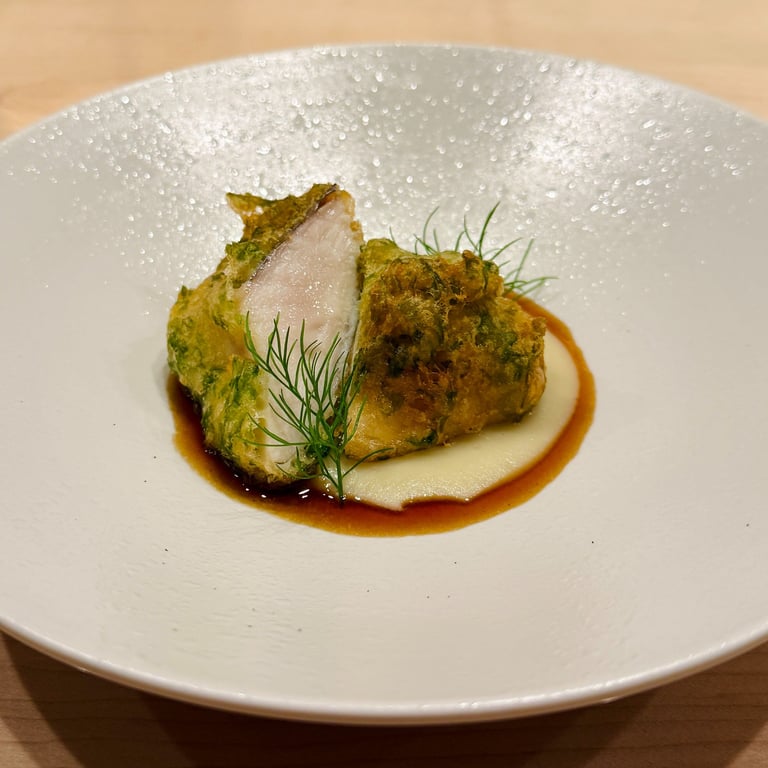
King Mackerel Beignet (Photo by Junko Y.)
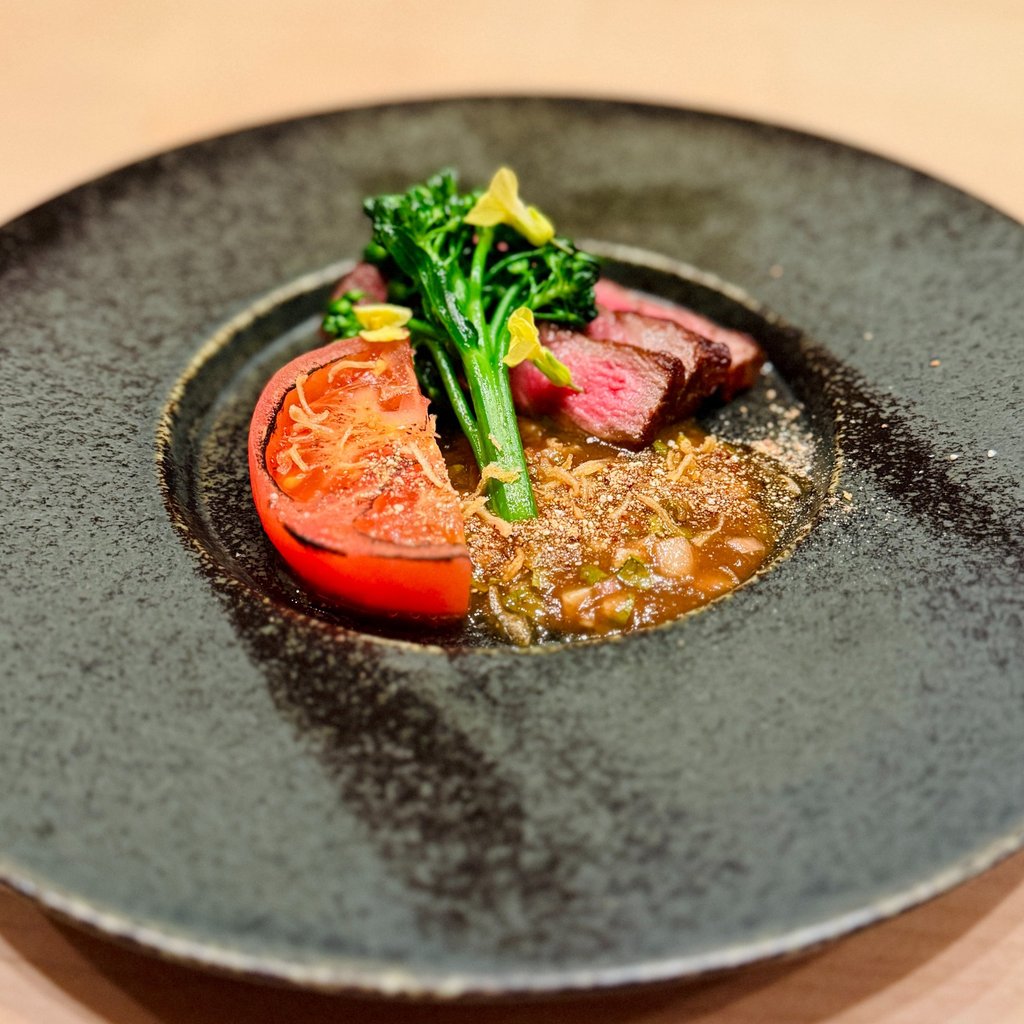
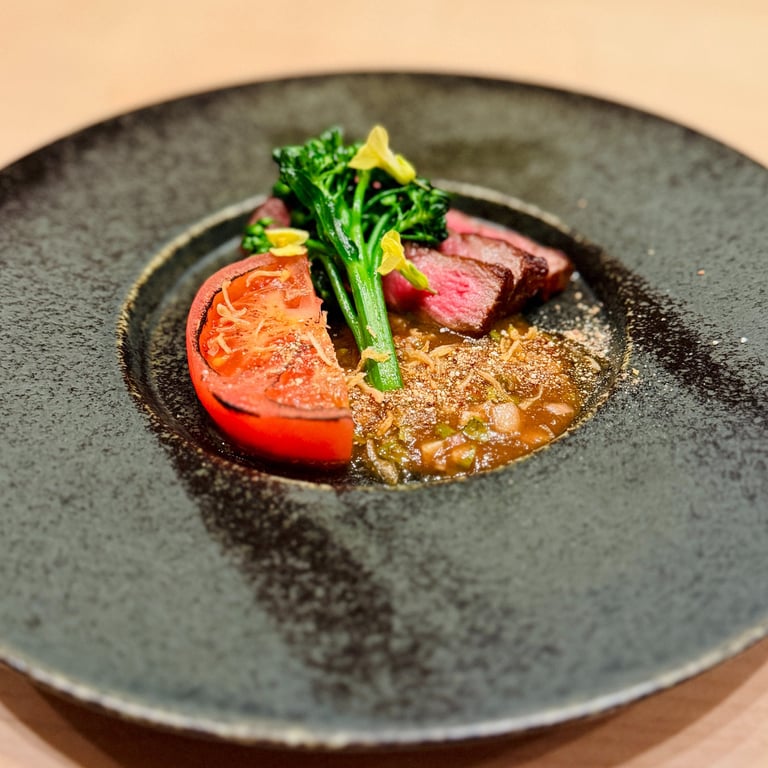
American Wagyu (Photo by Junko Y.)
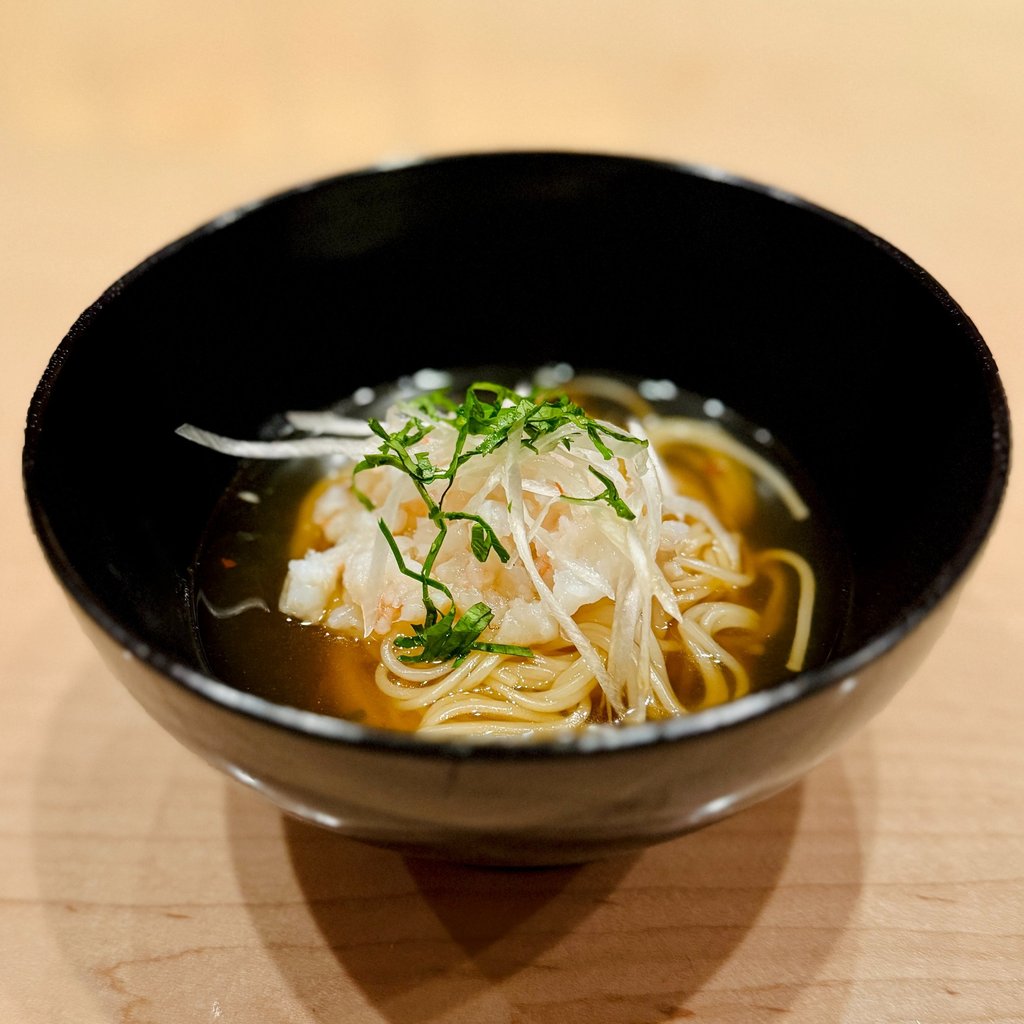
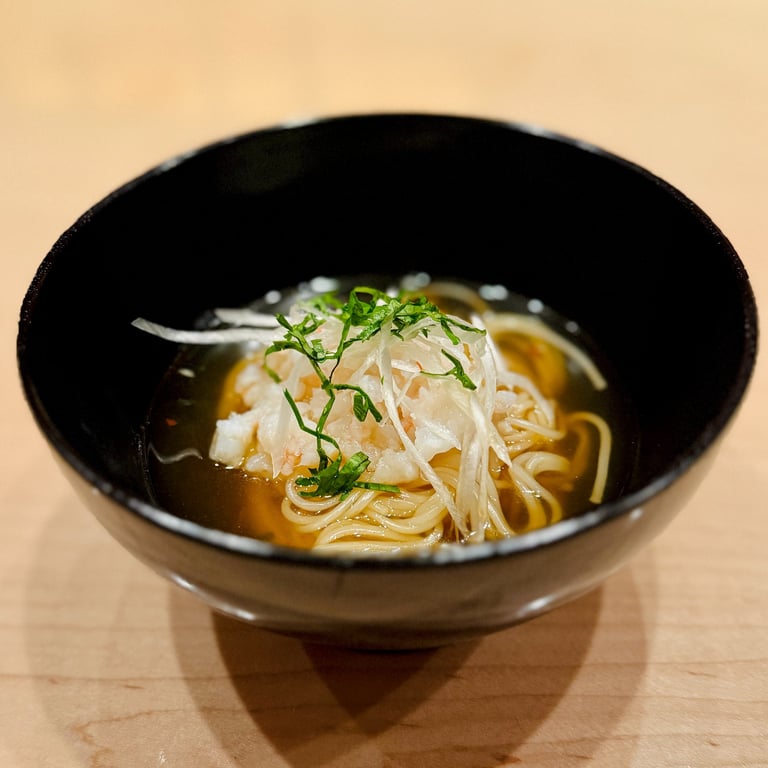
Somen Noodles (Photo by Junko Y.)
The final savory course was somen noodles in a shrimp tom yum broth made from shrimp heads. In Japan, somen is often enjoyed with aromatic condiments—ginger, myoga, and scallion—so the idea of pairing the noodles with additional spices is not unfamiliar. What felt original here was the use of traditional Thai aromatics and spice, bringing the character of tom yum into the dish.
Despite the assertive nature of tom yum, the flavor and spice were carefully moderated, never overwhelming the delicate noodles.
In many kitchens somen tends to soften too much, yet here the noodles were cooked with precise timing, preserving their fine texture in the broth.
Having eaten countless variations of somen since childhood, this Southeast Asian interpretation felt entirely new to me. As the concluding savory dish, it functioned as a fitting shime—a closing noodle course that brought the savory progression to a composed and lingering finish.
The Desserts
The meal concluded with two dessert courses, each composed with the same sense of balance that guided the savory progression. The first was named Lime Thai Tea. Within the form were lime jelly and chilled Thai tea granita, punctuated by tiny pearls of finger lime that burst with crisp acidity, creating a playful contrast of temperature and texture. The cold granita, citrus brightness, and subtle sweetness of Thai tea worked together to refresh the palate after the richness of the preceding courses.
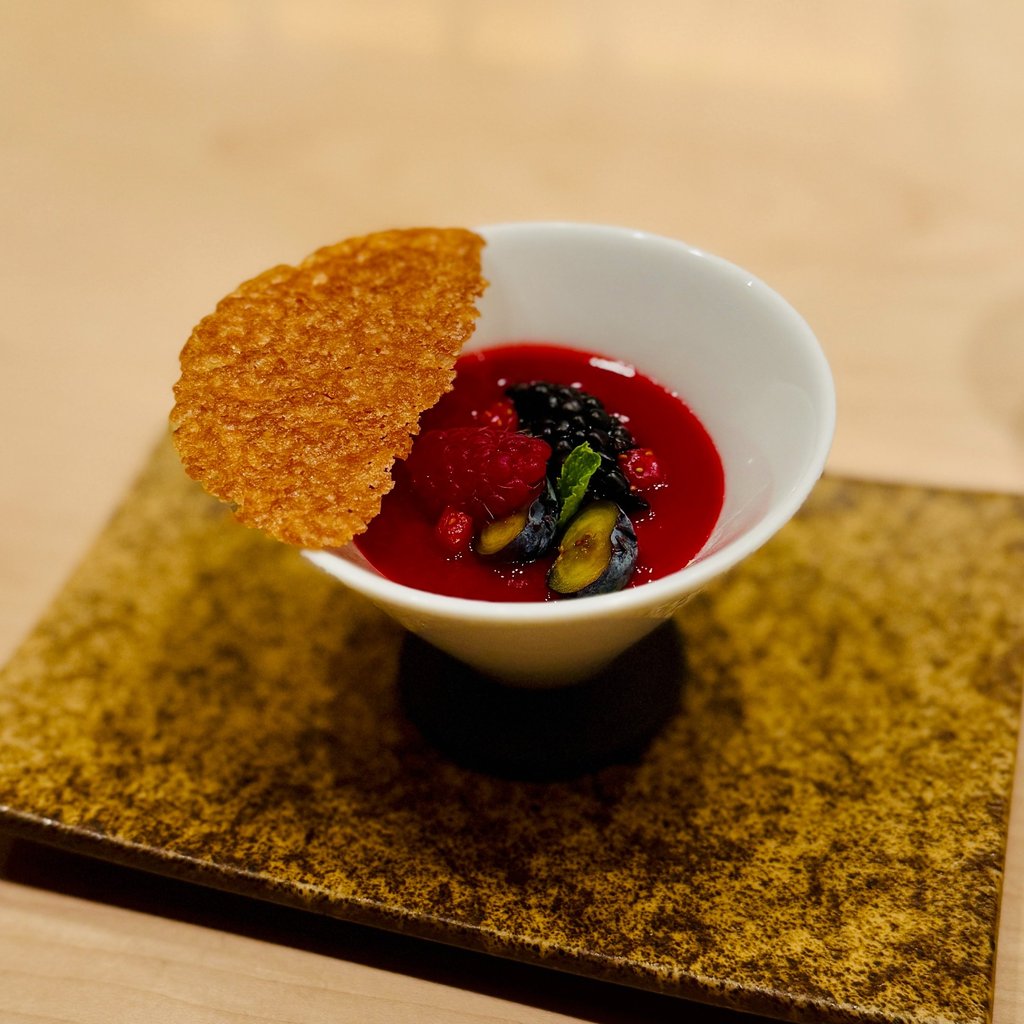
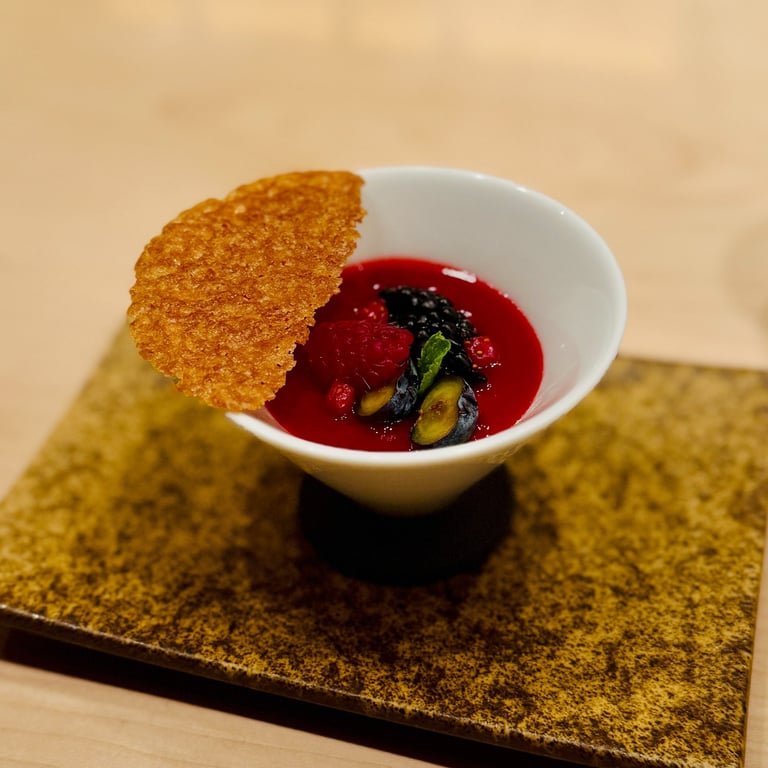
The second dessert arrived as a pudding with raspberry sauce, topped with a crisp almond cookie. The pudding itself was soft and gently sweet, while the raspberry brought a light tartness that kept the composition lively without becoming heavy. Taken together, the two desserts provided a clean and refreshing conclusion to a meal that had already unfolded across more than ten courses. As guests prepared to depart, a small matcha cake was presented to take home—a final, thoughtful gesture that extended the experience beyond the immediate setting.
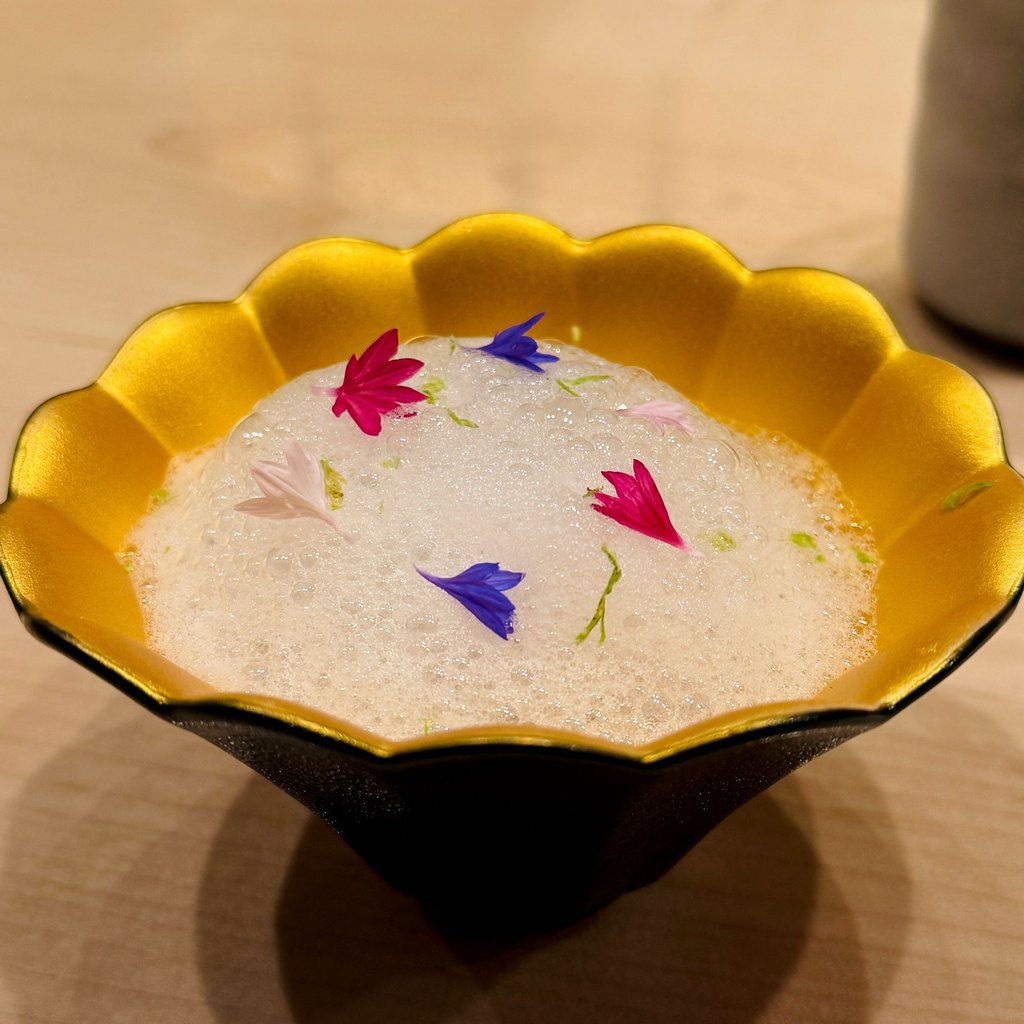
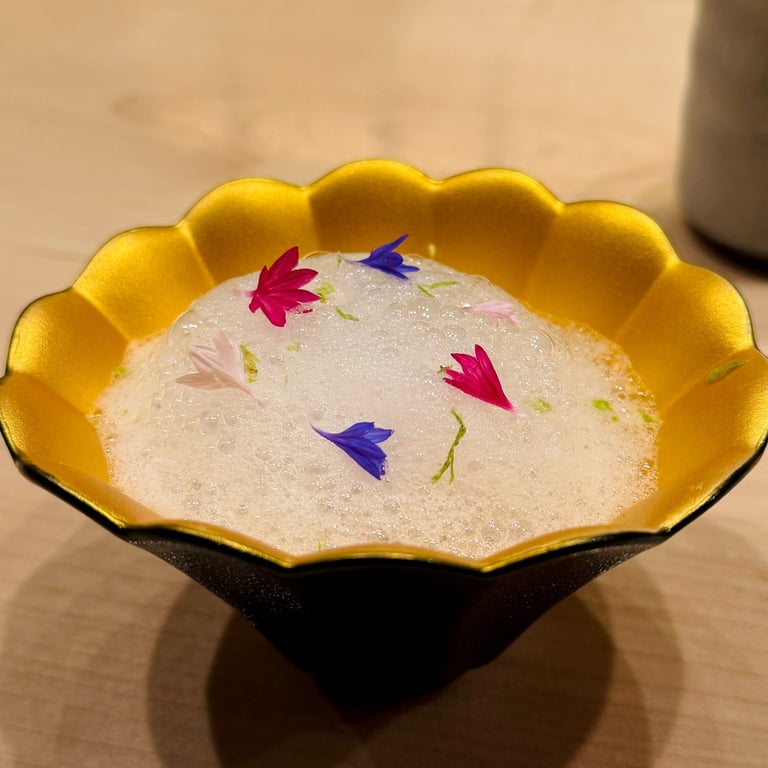
Lime Thai Tea (Photo by Junko Y.)
Pudding (Photo by Junko Y.)
The Final Thought
Coming from Tokyo, my interest in pursuing Japanese omakase in California lies not in replication, but in experiencing something rooted in tradition while offering a perspective I would be unlikely to encounter in Japan. In a place shaped by many cultures, creativity often emerges through exchange rather than departure. Within this context, Maison Kanatha presents a proposition that may initially invite hesitation. Many diners in California remain more accustomed to classic sushi or kaiseki counters, making a Japanese, French, and Thai omakase difficult to imagine at first—one that resists easy categorization and, in doing so, gently challenges expectations shaped by more orthodox formats.
Yet what unfolds is how naturally these ideas come together. Under the direction of Chef Kato and Chef Niki, the menu reveals a thoughtful sensibility—one that engages with the structural philosophy of kaiseki while extending its vocabulary through a broader, more global lens. Chef Kato’s grounding in Japanese culinary tradition is evident, but equally compelling is his fluency in the Japanese–French idiom long appreciated among discerning diners in Japan. This duality is not presented as contrast, but rather as a continuum.
The integration of Thai elements is carefully handled with particular restraint. Rather than asserting themselves, they are calibrated with precision—interwoven with components such as dashi—to illuminate the intrinsic character of the primary ingredient. Whether shellfish or monkfish, the treatment reflects not an effort to amplify flavor in isolation, but to articulate its inner structure. Such an approach demands both technical acuity and a highly attuned understanding of ingredients—an ability to elevate them beyond their immediate sensory impression toward something more considered, more resonant.
In this, the cuisine achieves a humble but persuasive coherence. Each composition feels measured, intentional, and ultimately in service of deepening one’s appreciation of the ingredient itself—sozai in its truest sense.
As Southeast Asian influences continue to find their place in contemporary dining, Maison Kanatha occupies a particularly compelling position. Its evolution will be worth close attention, not merely as a singular restaurant, but as a possible indicator of a broader recalibration within American fine dining—one shaped by cultural plurality, technical rigor, and a willingness to move beyond inherited forms.
True to the spirit embedded in its name, Kanatha advances the experience beyond the boundaries of the familiar, guiding the diner into a space where traditions converge not as compromise, but as a newly articulated harmony—precise, assured, and distinctly of its place.
Visited: February 22, 2026


Related Stories